
Erin Hills
A walking-only U.S. Open host rolling across the glacial humps of southeastern Wisconsin — vast, fescue-framed, and open to anyone with a reservation and a strong pair of legs.
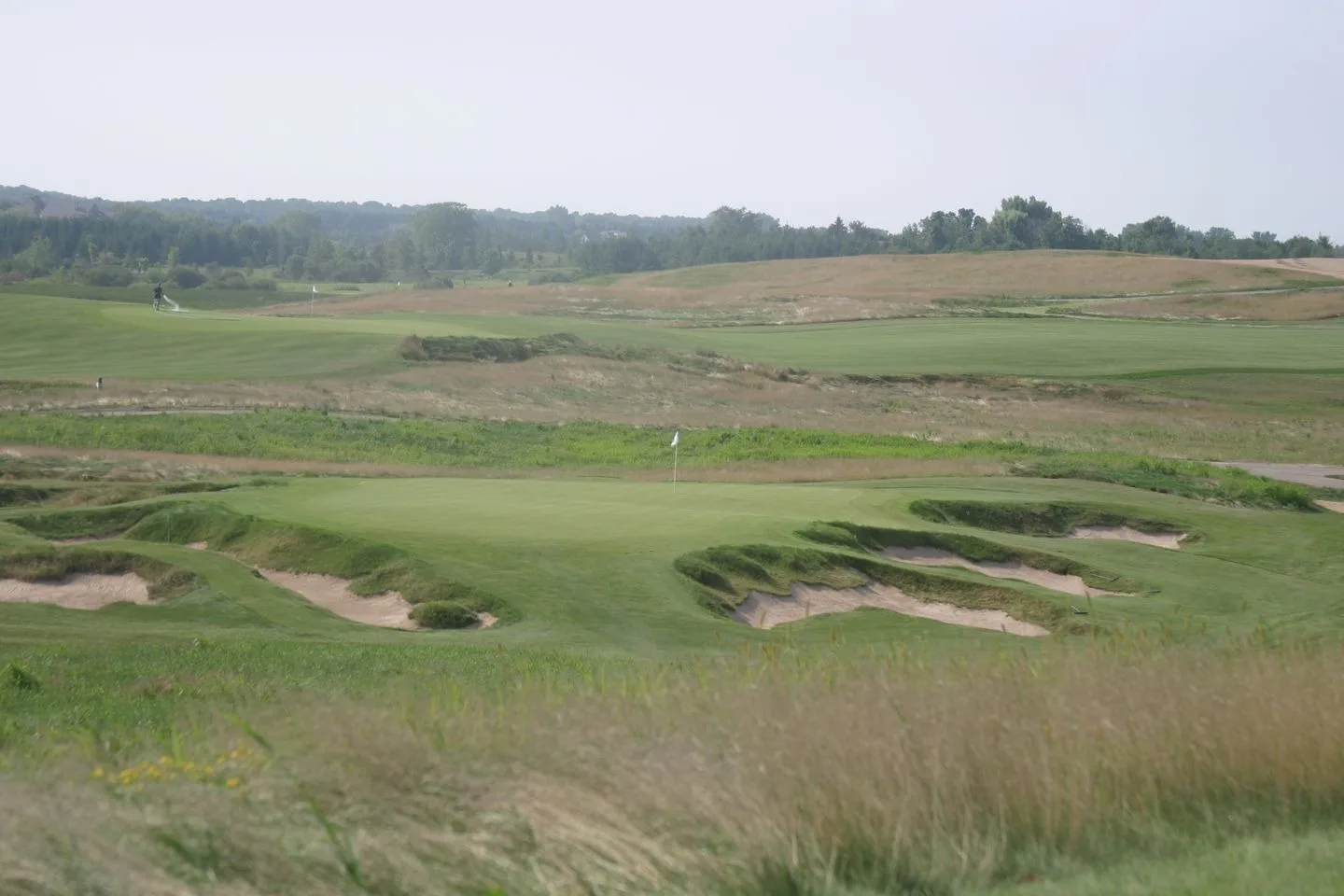
Some courses are carved into the land. Erin Hills was barely touched — the architects found their eighteen holes in the glacial humps and kettles of southeastern Wisconsin and let the terrain do the talking. The result is vast, raw, and fescue-framed, a walking-only test that was good enough to host a U.S. Open just eleven years after it opened. You don’t attack Erin Hills so much as survive your long walk across it.
| Yards | Rating | Slope | |
|---|---|---|---|
| Tips | 7,772 | 78.1 | 146 |
| Regular | 6,829 | 73.5 | 135 |
How it plays
Wide and windy. The fairways are generous by modern championship standards, but the fescue that frames them is penal, the greens are big and bold, and the wind across this open, treeless ground is the course’s real defense. From the back it’s a monster; from a sensible set it’s a thrilling, playable romp. Either way you’re walking every yard, so pace yourself — the closing holes are a long way from the clubhouse and the legs matter as much as the swing.
You don’t attack Erin Hills. You survive your long walk across it.
The pedigree
Erin Hills announced itself fast: a U.S. Amateur in 2011, then the 2017 U.S. Open, where Brooks Koepka tied the championship’s all-time scoring record at sixteen under. For a course that opened in 2006 on a shoestring compared to the resort giants, earning an Open that quickly is a staggering endorsement — and unlike most Open venues, this one takes public tee times.
Plan your visit
It’s about 45 minutes northwest of Milwaukee, deep in the Kettle Moraine country — remote enough to feel like an occasion. Green fees for the 2027 season run $435 in the shoulder to $555 at peak. Book ahead, plan to walk with a caddie (there’s no cart, and no push or pull cart), and hire that caddie your first time to help with lines on the blind and rumpled holes. There’s lodging on site, so you can make a night of it, and the whole eastern-Wisconsin golf trail — Whistling Straits, Lawsonia — is within reach for a longer swing.
Who should play here
Walkers and championship-golf romantics who want to tee it up where the pros suffered. Erin Hills is big, exposed, and demanding, and it asks for your legs as much as your game — not the day for a cart-only player or a fragile back. But if you’ll make the walk, it’s one of the few U.S. Open stages in the country that anyone can book.
Erin Hills, quickly
- Can anyone play Erin Hills?
- Yes — it's a public, daily-fee course open to all. It's walking-only, with caddies available and recommended.
- Did Erin Hills host the U.S. Open?
- Yes, in 2017 — Brooks Koepka won at 16-under-par, tying the championship scoring record. It was a relatively young course for an Open, having opened in 2006.
- Do you have to walk Erin Hills?
- Yes. Erin Hills is walking-only. Hire a caddie or walk and carry. No push or pull carts. Expect a genuine hike across the glacial terrain.
- Who designed Erin Hills?
- The team of Dr. Michael Hurdzan, Dana Fry, and golf writer Ron Whitten, working with the natural glacial landforms of the site. It opened in 2006.
We may earn a commission on the tee-time link above — we only point you where we’d book ourselves. Scorecard figures are illustrative.